Showing posts with label africa. Show all posts
Showing posts with label africa. Show all posts
Tuesday, November 13, 2007
One Laptop Per Child - Give One Get One Opportunity
Masi Oka speaks on behalf of the One Laptop per Child (OLPC) Foundation regarding the Give One Get One opportunity.
Starting November 12, One Laptop Per Child will be offering a Give One Get One Program for a brief window of time in North America. For $399, you will be purchasing two XO laptops—one that will be sent to empower a child to learn in a developing nation, and one that will be sent to your child at home.
For more information, please call 1-877-70-LAPTOP or visit http://www.laptopgiving.org/

Thursday, November 01, 2007
Ubuntu rocks walmart and education

I am a big fan of open source technologies especially in the realm of education. Because open source technologies are free to use, many people mistakenly assume they are inferior in quality and support. However, this couldn't be further from the truth. For example, the $100 laptop program runs on a modified open source distribution of linux. Moodle is used in schools and universities world-wide and it is a free open source Learning Management System that can be scaled from 1 user to 50,000 users. Open Office is a free open source office suite, which is quite comparable to the expensive and market dominating MS Office Suite.
The desktop computer has been dominated by Windows and challenged by Apple (You the know the commercials, I am a PC...I'm a MAC). However, is it possible that a free open source operating system can compete with the big dogs? Well, with the huge shift in the wide-scale use of web applications and the ever increasing role of the google online empire, an open source operating system might be in a prime position to really compete in the market. Plus, it helps to get a boost from the biggest retail store in the world, Wal-mart. Recently, Wal-Mart announced that they will be selling a $200 computer running the Ubuntu Linux Operating System. For those curious about Ubuntu, Mike Kudela, instructional designer for BGSU, wrote an informative article about Ubuntu for the BGSU distance learning newsletter, titled "I'm a Mac, I'm a PC, I'm an Ubuntu?"
I have a passion for spreading education in underdeveloped areas in the US and around the world and I think open source can play a major role in connecting the human netork and Ubuntu computers would be a great way to get the ball rolling. Thanks to Brian Childs for sending me the links to this info.
Monday, July 23, 2007
$100 Laptop Production Begins

I think it is appropriate that Brian Childs, our BGSU IDEAL liaison in Kenya, Africa, actually IM'd me this story just a few minutes ago. I have written about the $100 Laptop program several times on this blog regarding the affect it could have on the progress of worldwide education. We are currently assessing the technological capabilities in Kenya and TZ for future delivery of online courses in Africa and the $100 laptop program might be a huge part of the puzzle. Contrary to the name of the laptop, it is not cheap in the sense of quality. The $100 laptops actually use state of the art technology for durability, wi-fi, energy efficiency, and more.
"Five years after the concept was first proposed, the so-called $100 laptop is poised to go into mass production. Hardware suppliers have been given the green light to ramp-up production of all of the components needed to build millions of the low-cost machines. Previously, the organisation behind the scheme said that it required orders for 3m laptops to make production viable. The first machines should be ready to put into the hands of children in developing countries in October 2007."
Watch the video clip.
Monday, March 05, 2007
$100 Laptop Program - TED video
"Nicholas Negroponte is former Director of the MIT Media Lab, and founder of the non-profit, One Laptop Per Child, dedicated to making the famed $100 laptop a reality. In this talk, he outlines some of the challenges of getting a $100 laptop produced, and explains why he stepped down as Media Lab director to focus on it full-time, "for the rest of my life." (Recorded February 2006 in Monterey, CA. Duration: 18:21)
Wednesday, December 13, 2006
Skype 3.0

Video and audio communication over the internet adds some really neat aspects to online teaching and learning. Would you like to call or video conference anyone in the world for free using your computer? Would you pay $15 a year to call any landline phone with your computer in the US and Canada? Would you like to to do some free video conferencing online with your students? How might these techniques enhance your online course? I'm no salesperson, but I will advocate something if I think it can benefit education and Skype is one nice application that uses peer to peer technology to enhance online communication. Check out their most recent version--- Skype 3.0
I am looking forward to the day that my students and colleagues in the 3rd world will call me for free from their $100 laptops. The global classroom is just around the corner.
Feel free to give me a call sometime via skype. My skype name is terenceonline
Thursday, November 30, 2006
$150, Third-World Laptop...Will it Change the World?
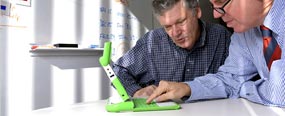
Today's NY Times article titled, "For $150, Third-World Laptop Stirs a Big Debate" brings to light some extremely interesting discussion. Namely, what are the essentials for educational and economic development in third world countries? Nicholas Negroponte, an MIT computer researcher, began the $100 laptop program which aims at creating laptops for the third world for under $100. Currently there at $150 but projected to be under $100 by 2008. This might sound easy to some since Dell doesn't seem to be to far off the mark with their own $500 laptop, however, there are different conditions to overcome for use of a laptop in the third world. For example:
- "Each machine will come with a simple mechanism for recharging itself when a standard power outlet is not available."
- A foot pedal and hand pulled device can be used to generate electricity.
- The computers lack a hard drive but use solid state memory instead, and the processors turn off automatically when not in use.
- The software is based on the free Linux Operating system, a rival of Windows. It will also used a stripped down web browser, some simple learning programs, and Google's gmail for email.
- A video camera lens is included on the machine for video conferencing and digital pictures.
- To include wireless network capability, they use a range of methods depending on local conditions. "In some countries, like Libya, satellite downlinks will be used. In others, like Nigeria, the existing cellular data network will provide connections, and in some places specially designed long-range Wi-Fi antennas will extend the wireless Internet to rural areas.
I've posted in a previous blog article that Africa is becoming the largest consumer of cell phones in the world. This is awesome to hear because it represents the wireless network that is being built and that computers can tap into. I don't know what the connection speed will be like for these computers and networks, however, making them wireless accessible is a step in the right direction. My university, Bowling Green State University, is passionate about bringing education to the third world via distance technologies and hopefully it won't be long before students at BGSU share a classroom with not only visiting international students, but with people actually living in all parts of the world. What a rich learning environment that would be for everyone.
Wednesday, October 25, 2006
MIT research scientist goes to Africa to study mobile technology
 MIT Research Scientist, Dr. Nathan Eagle, goes to Kenya to research and study the future of mobile technology (i.e. cell phones). Why Africa you might ask? According the the MIT website, "Africa is well-suited as a testbed for the development of a mobile phone programming curriculum. Given their massive adoption and widespread use, as well as the recent technological advances in their computational power, mobile phones are ideal substitutes for the personal computer throughout the continent." Here are some more statistics about Africa and mobile technology from the MIT site:
This is very interesting research for those of us that are interested in working to enable Africa with greater access to university education via online technologies. Dr. Bruce Edwards, Associate Dean of Distance Learning at BGSU, has traveled extensively to East Africa and is dedicated to bringing more education to the developing regions. I may also be traveling to Tanzania in the next year or so to explore the logistics of setting up a distance learning center on behalf of BGSU.
- Worldwide, there are more than 2.4 billion cellphone users, with more than 1,000 new customers added every minute.
- 59 percent of these 2.4 billion people live in developing countries, making cellphones the first telecommunications technology in history to have more users there than in the developed world.
- Mobile phone shipments grew 19 percent to 810 million units in 2005 and are expected to rise by 15 percent to 930 million units in 2006
- Cellphone usage in Africa is growing almost twice as fast as any other region and jumped from 63 million users two years ago to 152 million today.
Subscribe to:
Posts (Atom)