UPDATE: The blogger to twitter task has not been working, however the Google Reader to Twitter Task worked fine.
Showing posts with label education. Show all posts
Showing posts with label education. Show all posts
Thursday, April 26, 2012
Exploring the "if this then that" web app: making the Internet work for you
I discovered a neat little web app called ifttt (if this then that) that makes it easy and fun to run "if/then" statements across the internet by utilizing API's of various web apps such as twitter, google reader, instagram, and many more. For example, I set up three if/then tasks to see how it works. The first task I set up was IF I upload a picture to Instagram THEN automatically save a copy of it in my Dropbox. The second task I set up was IF I make a blog post here on blogger, THEN automatically send a tweet out to my terenceonline twitter followers. The third task I set up was IF I star an article in Google Reader THEN send a tweet out to my terenceonline twitter followers linking them to the starred article. There are numerous other if/then statements you can set up and I think people will find ways to get creative with it. This is similar to what Yahoo Pipes was doing back in the day,but this is bit more simple to use. The only draw back I see right now is that you have to authorize IFTTT to access all of the accounts you set up, which isn't uncommon theses days, but may make some people nervous. If you found this article from my twitter then the IFTTT task worked. What are some neat ways that educators can take advantage of IFTTT? One more thing -- This IFTTT recipe page is pretty cool to get ideas of how people are using it http://ifttt.com/recipes
UPDATE: The blogger to twitter task has not been working, however the Google Reader to Twitter Task worked fine.
UPDATE: The blogger to twitter task has not been working, however the Google Reader to Twitter Task worked fine.

Wednesday, July 20, 2011
Reverse the lecture paradigm
Rather than teachers lecturing (sometimes poorly) and kids doing homework at home (sometimes poorly), kids watch world-class lectures at home and do exercises in class with their teachers, who are best for such personalized interaction. Agree or disagree?
Tuesday, April 05, 2011
Khan Academy is Tip of the Iceberg in Education Reform
The first time I learned about the Khan Academy about a year ago, I thought, "this is just the tip of the iceberg in reforming education." I posted Sal Khan's TED talk a few posts ago and I recommend checking that out if you are unfamiliar with his story. Free, easy to follow, online educational videos in subjects such as math, history, science, languages, etc will equip schools like never before. Instead of getting lectures and lessons in class and getting homework at home, we flip that around. We get the lectures at home via free video tutorials and online lessons and we get hands on learning, active discussion, and assistance from the teacher during class in real-time. The online videos actually make it easier for the student to learn as they can pause, rewind, and fast forward the videos. The Khan Academy is loading thousands and thousands of curriculum based videos to the web for free along with assignments, quizzes, and even games that encourage achievements in learning. Khan says his method of learning, "will liberate teachers from the standard "one-size-fits-all" lesson plan and help to "humanize the classroom." I think these videos represent just a fraction of the potential that can be harnessed in online and blended learning. The fact that one guy made thousands of educational videos that are actually pretty good, will give schools something to think about regarding how they can use asynchronous learning to improve the educational system. These are exciting times. Check out this article - http://www.huffingtonpost.com/2011/04/04/the-khan-academy-and-educ_n_844390.html
Wednesday, March 09, 2011
Let's use video (and the internet) to reinvent education
Salman Khan talks about how and why he created the remarkable Khan Academy, a carefully structured series of educational videos offering complete curricula in math and, now, other subjects. He shows the power of interactive exercises, and calls for teachers to consider flipping the traditional classroom script -- give students video lectures to watch at home, and do "homework" in the classroom with the teacher available to help.
Wednesday, February 16, 2011
One Idea on How to Fix Our Broken K-12 Educational System
I found the following idea from http://www.ideasforourfuture.com/ pretty interesting and wondered what others think (It is listed under TOPIC 4). I recommend reading and discussing the pros and cons of the other ideas on the site as well with your peers, colleagues, and classmates. These would be great problems to tackle in our schools.
This problem deals with the question "How can we Fix Our Broken K-12 Educational System?" PROPOSED ANSWER: Recruit Our Top Teachers and Produce EXCITING World-Class Lessons on Video and use them in both the online and face to face classrooms of the world.
Big Ideas:
- The idea starts as an ingenious new reality TV show, selecting the absolute best K-12 teachers (for every grade and every subject) in the USA.
- the winning teachers (one for every grade & every subject) will be professionally video recorded in their actual home classrooms for one entire school year
- The half-hour videos, one for each class period, will give the home classroom teacher equal time per hour to introduce, pause the show, elicit classroom comment and answer questions. The videos won’t be a "threat" to the home teachers; rather, CS will relieve them of having to insure required material is presented, as well as relieving them of having to prepare their daily lessons.
- In-class teachers will be inspired by the excellent teaching examples and by the possibility of someday becoming celebrity teachers themselves.
- CS videos will be universally available (i would add online) for take-home use (repetitive viewing is crucial) and for family entertainment.
- CS will bring top quality education to the poorest urban ghetto schools and the tiniest country schools all over the country. They will be made available to prison inmates to view (and finally get a quality education) rather than watching ordinary TV or video games. The videos are a natural for the internet and will also be shown on dedicated CS TV channels as "edu-tainment", similar to Nova, Cosmos, Discovery & the History Channel (but much more exciting to watch).
What do you think about this idea? Pros and Cons? Why haven't we leveraged our best teachers in the world in such a systemic and organized way?
Friday, October 15, 2010
Powerful Lecture by Sir Ken Robinson on the Need For a Changing Educational Paradigm
I enjoyed both the content of this lecture and the creative way in which it was produced. I love how the art in this video engaged and connected my brain to the content of the lecture itself. I could see this communication method as a very powerful online learning tool where artists and teachers collaborate to engage the learners. Check it out
Tuesday, March 23, 2010
Jetpack for Learning” Design Challenge Winners Announced at SXSW : The Mozilla Blog
“Jetpack for Learning” Design Challenge Winners Announced at SXSW :: The Mozilla Blog

“Jetpack for Learning” Design Challenge Winners Announced at SXSW
Posted by Erica Jostedt
March 14th, 2010 · Mozilla Labs, Mozilla News
Editor’s note: On March 13, Mozilla Labs announced the Jetpack for Learning Design Challenge winners at the the Mozilla SXSW Happy Hour. For more details, check out Aza Raskin’s announcement on the Mozilla Labs blog, reposted below:
Three projects of the Jetpack for Learning Design Challenge were awarded special prizes at the Mozilla SXSW party today. Ten projects already selected as Design Challenge winners participated in a design camp in Austin, TX over the past three days. Today three of these projects were chosen for special awards: ClozeFox was selected as “best use case”; the project leader of Mupple received the prize for “sharing knowledge with others”; Expression Widgets was chosen as the “best web hack”. You can find more information about them and download all Jetpacks-based add-ons from the Design Challenge wiki.
Thursday, December 03, 2009
How does distance learning, social networking, and other new media enrich your life?
I was recently asked the question, "How does distance learning, social networking, and other new media enrich your life … your career?" and here was my reply:
I define distance learning as any method of teaching and learning that is not dependent on a geographic location. Therefore, most of our world is falling into this category and enriching our lives in one way or another. Online banking, shopping, music, education, etc...The distance technologies enable us to prioritize our lives around the things that matter most to us, such as our families, friends, community, and organizations we are passionate about. Distance technologies facilitate a brand new form of asynchronous communication that enables us to prioritize and schedule our lives more effectively. This is a major reason why distance learning in higher education has spread like wildfire and continues to grow. It's not that online learning is easier or of lower quality (see research), it is that formal education can now revolve around a person's life rather than the other way around. It's only the next natural step. I have seen the growth and increased demand of distance education at BGSU first hand and am very excited about BGSU being chosen by the Ohio Board of Regents as a Center of Excellence for E-learning in the State of Ohio. E-learning doesn't replace face to face universities but enhances them by meeting the new needs of a new generation of students, both young and old.
Let's change gears and look at facebook and twitter as two distance technologies that are changing the world around us. Twitter allows me to get news and information from the people and organizations that interest me the most. Therefore, by subscribing to various twitter feeds, I can get the latest deals from amazon, stay on top of the latest technologies from apple, google, and other tech companies, and get words of inspiration from my pastor or other pastors I listen to online throughout the day. This is awesome. I am also able to re-tweet those to my community of followers, and they, their followers. You see how information is exploding there? With facebook, I am able to "keep in touch" with hundreds of friends at a distance. For example, this enables me to see pictures of my niece and nephews right after they were taken, which prompts me to comment on them or call them. You see how this technology interrupts our lives, but can do so in a positive way. Ever wonder what happened to your old high school buddies? With facebook, you can stay in touch with them on a surface level so that if your relationship with them ever re-surfaces when you run into them in person, you will have much to talk about and build on. The technology is not meant to replace relationships, but if used with wisdom, enhance them. RSS feeds, blogs, podcasts, Wikipedia, YouTube has greatly impacted my career in that I am able to subscribe to content all over the internet and have it directly imported to my email inbox or RSS reader. This enables me to stay on top of the latest in the field of distance learning as well as contribute to the conversation with my own blog posts or tweets.
I define distance learning as any method of teaching and learning that is not dependent on a geographic location. Therefore, most of our world is falling into this category and enriching our lives in one way or another. Online banking, shopping, music, education, etc...The distance technologies enable us to prioritize our lives around the things that matter most to us, such as our families, friends, community, and organizations we are passionate about. Distance technologies facilitate a brand new form of asynchronous communication that enables us to prioritize and schedule our lives more effectively. This is a major reason why distance learning in higher education has spread like wildfire and continues to grow. It's not that online learning is easier or of lower quality (see research), it is that formal education can now revolve around a person's life rather than the other way around. It's only the next natural step. I have seen the growth and increased demand of distance education at BGSU first hand and am very excited about BGSU being chosen by the Ohio Board of Regents as a Center of Excellence for E-learning in the State of Ohio. E-learning doesn't replace face to face universities but enhances them by meeting the new needs of a new generation of students, both young and old.
Let's change gears and look at facebook and twitter as two distance technologies that are changing the world around us. Twitter allows me to get news and information from the people and organizations that interest me the most. Therefore, by subscribing to various twitter feeds, I can get the latest deals from amazon, stay on top of the latest technologies from apple, google, and other tech companies, and get words of inspiration from my pastor or other pastors I listen to online throughout the day. This is awesome. I am also able to re-tweet those to my community of followers, and they, their followers. You see how information is exploding there? With facebook, I am able to "keep in touch" with hundreds of friends at a distance. For example, this enables me to see pictures of my niece and nephews right after they were taken, which prompts me to comment on them or call them. You see how this technology interrupts our lives, but can do so in a positive way. Ever wonder what happened to your old high school buddies? With facebook, you can stay in touch with them on a surface level so that if your relationship with them ever re-surfaces when you run into them in person, you will have much to talk about and build on. The technology is not meant to replace relationships, but if used with wisdom, enhance them. RSS feeds, blogs, podcasts, Wikipedia, YouTube has greatly impacted my career in that I am able to subscribe to content all over the internet and have it directly imported to my email inbox or RSS reader. This enables me to stay on top of the latest in the field of distance learning as well as contribute to the conversation with my own blog posts or tweets.
Thursday, August 27, 2009
The World is Open
News: 'The World Is Open' - Inside Higher Ed
A very fascinating read. The open access to educational materials and experts is virtually limitless. What role do universities play in such an open educational world. For example, in years past, one aspect of accreditation for colleges involved access to scholarly journals, but as the article reveals in the following quote, this has changed drastically in the information age, "When I was in primary school in the 1960s and 1970s, I had to walk next door to borrow the Compton Encyclopedia volume that I needed. They were free for me to use when the neighbors were home. Today, Yahoo! Education provides free access to the Roget’s II Thesaurus (260,000 synonyms and cross references), Colombia Encyclopedia (more than 50,000 entries and 84,000 hypertext cross-references between the content), and American Heritage Dictionary (definitions, word spellings, and word suggestions as well as more than 200,000 entries, 70,000 audio word pronunciations, and 900 full-page color illustrations). If that is not enough, there is the Encyclopedia Britannica, and yes, that trusty Wikipedia that is now the seventh most accessed Web site in the United States." After reading the article, "What are a few ways you expect these movements to change higher education in another 10 or 20 years?"

Technology is changing higher education in more ways than can be counted. Distance education has become common. Leading universities are putting course materials or even entire courses online -- free. The Obama plan for community colleges envisions free online courses that could be used nationwide. Curtis J. Bonk, a professor of instructional systems technology at Indiana University, surveys this landscape in The World Is Open: How Web Technology is Revolutionizing Education (Jossey-Bass). Bonk responded to questions about the book in an e-mail interview.
A very fascinating read. The open access to educational materials and experts is virtually limitless. What role do universities play in such an open educational world. For example, in years past, one aspect of accreditation for colleges involved access to scholarly journals, but as the article reveals in the following quote, this has changed drastically in the information age, "When I was in primary school in the 1960s and 1970s, I had to walk next door to borrow the Compton Encyclopedia volume that I needed. They were free for me to use when the neighbors were home. Today, Yahoo! Education provides free access to the Roget’s II Thesaurus (260,000 synonyms and cross references), Colombia Encyclopedia (more than 50,000 entries and 84,000 hypertext cross-references between the content), and American Heritage Dictionary (definitions, word spellings, and word suggestions as well as more than 200,000 entries, 70,000 audio word pronunciations, and 900 full-page color illustrations). If that is not enough, there is the Encyclopedia Britannica, and yes, that trusty Wikipedia that is now the seventh most accessed Web site in the United States." After reading the article, "What are a few ways you expect these movements to change higher education in another 10 or 20 years?"
Thursday, June 04, 2009
Colleges consider using blogs instead of blackboard: Getting closer, but not completely thought through, in my opinion
The article titled, "Colleges Consider Using Blogs Instead of Blackboard" in the Chronicle of Higher Education, gets some things right and some things wrong, in my opinion. I want to keep this somewhat short because I could write a novel on this topic. First, they understand that paying hundreds of thousands of dollars for Blackboard might not be the best technological solution to facilitate learning. Second, they have experienced the sheer power of the Wordpress blogging platform, which can be used to develop websites that facilitate online learning, eportfolios, blogs, and more... PLUS it's OPEN SOURCE. Yes, it's license free. "What? Something must be wrong with it then." Nope, only one's inability to understand open source software and how it works. We have implemented Wordpress at BGSU as the foundation of our web 2.0 learning landscape. The platform enables the brilliant minds of our university to easily consume, collaborate, communicate, and create content. It facilitates the publication of audio, video, images, and presentations quite easily. In fact, I am giving a presentation on our Wordpress project at the 2009 Moodle Moot/ Sloan-C Conference in San Francisco. In essence, the Wordpress Platform is very powerful and customizable and could be used to deliver great content. If the only thing they wanted a learning management system to do was to present content and provide an interactive platform for learning, then it would meet their needs just fine, but the Learning Management System must do more than that. Wordpress, without tons of customizations to the core, cannot and does not provide the same functionality that a Learning Management System can provide. A better direction for CUNY to go would be to continue to support Wordpress because it is an amazing teaching and learning platform, BUT ALSO look into implementing Moodle, an open source learning managements system, to replace Blackboard if they are unhappy with Blackboard. I personally think Blackboard and Moodle are equals with very different price tags. Either way, the technological infrastructure of Moodle and Blackboard is designed to do different things than the technology in Wordpress. For example, Moodle and Blackboard both have grade books, test creation tools, advanced discussion forums, assignment drop boxes, and they interface with a variety of Student Information Systems for enrollment management. To draw an analogy from a brick and mortar classroom, Moodle/Blackboard would be a classroom with a locked door equipped with chalkboard, desks, computers, projector, and other cool teaching and learning tools. Wordpress would be like equipping all the computers in the classroom with state of the art technology that enables the teachers and students to take teaching and learning to another level that neither Learning Management Systems can provide on their own. Yes, they will both claim to have blogging features, but as I stated before Wordpress is much more than a blogging platform. My point is that CUNY would be better off looking at Moodle and Wordpress as an open source alternative to Blackboard instead of just Wordpress.
Wolfram Alpha - Making the world's knowledge computable - Now What?
See ya later great knowledge memorizers of the world, and hello great knowledge appliers of the world. Is it me or are the people inhabiting this third rock from the sun, connecting, computing, and collecting knowledge like nothing we've ever seen before. Well, except for maybe the time we humans tried building that Tower of Babel, which ended up not working out so well. Introducing.... Wolfram Alpha, a powerful computational knowledge engine that seeks to make all systematic knowledge immediately computable by ANYONE. Connect this to a mobile device and we become walking and talking systematic knowledge carriers. We've had access to knowledge via the internet for quite some time, but this immediate access to systematic knowledge is something a little newer and worth pondering. I wonder if teachers will FINALLY stop creating tests that assess our students ability to memorize facts and start testing the application of those facts to solve real world problems. I'm especially looking at Universities to take up this challenge. With tools like Wolfram Alpha and Google Squared available to us, educational institutions should start building curriculum with the highest levels of Bloom's Taxonomy in mind. Maybe instructional designers could start with the fact that humans have access to just about all the available knowledge in the world and build from there. It sounds kind of funny, but it's true. This doesn't mean everyone understands the knowledge, but for the first time in history we do have easy access to it. Therefore, it is crucial we teach students where to find the knowledge, and then help them develop the skills to apply, analyse, synthesize, and evaluate it. We need to re-think assessment and skill acquisition for this day and age in this Knowledge Economy. It's time for schools to build curriculum that challenge us to really engage in the application of knowledge and not the memorization of definitions, forumulas, and factoids. That's lazy instruction. Yes, there is a place for memorizing in education...It is a good idea for teachers to memorize their students' names and interests. Personally, I don't care how great of a memorizor my accountant is. I want to know if that person can think about whole systems and solve financial problems that can save me money. What does it mean for you to have access to the world's systematic knowledge? How will you apply it? What does it mean for schools? How can they apply tools like Wofram Alpha and Google Squared to their curriculum. What does it mean for businesses? What do you think?

Wednesday, October 22, 2008
Google's Project 10^100 - Ideas that will change the world
Thanks to Connie Molnar for the info about Project 10^100, which is a call for ideas to change the world by helping as many people as possible.
Check out this video and don't forget to vote.
About the Project
Q: What is Project 10100? A: Project 10100 (pronounced "Project 10 to the 100th") is a call for ideas to change the world, in the hope of helping as many people as possible.
Q: Why is Google doing this? A: The short answer is that we think helping people is a good thing, and empowering people to help others is an even better thing. Here's the long answer.
Q: How many ideas are you funding? A: We have committed $10 million to fund up to five ideas selected by our advisory board.
Q. Why the name 10100? A: 10100 is another way of expressing the number "googol," a one followed by one hundred zeroes. Our company's very name expresses our goal of achieving great results through smart technology that starts small and scales dramatically over time to have a tremendous long-term impact. Project 10100 is a similar attempt to produce those kinds of scalable results by harnessing our users' insights and creativity. We don't know what ideas would help the most people. This project's premise is that maybe you do.
Check out this video and don't forget to vote.
Wednesday, September 10, 2008
Free Book Opportunity!
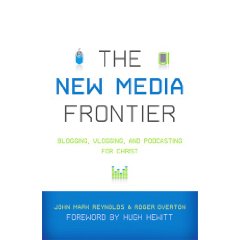 Everyone loves free stuff - so how about a free copy of The New Media Frontier, by John Mark Reynolds and Roger Overton. I contributed to the book by co-writing chapter 5 on podcasting and new media. Crossway, the publisher, will be sending a free copy of the book to the first 30 people who agree to post a review on their blog or Facebook page. Here are the details:
- Send an email to marketing@crossway.org with the subject "New Media Frontier Giveaway" with your name, mailing address, and blog address.
- Crossway will send you a shiny new copy of The New Media Frontier.
- Read the book and post a review on either a blog or your Facebook profile so all your friends can see it by October 31st, 2008.
- Cross-post your review on Amazon.com
Monday, August 04, 2008
11 Things You Shouldn’t Leave For School Without
11 Things You Shouldn’t Leave For School Without
A simple list to simplify your life. When you first arrive at college you will be introduced to problems that you never knew existed. While no list will ever include a solution to all of your ills, this one hits on some things that you may not have considered.Though I haven't tried all of these services, some of them look pretty cool. For example, at Ottobib.com, you can enter the book’s name or ISBN, and this website does your bibliography for you in any format.
Wednesday, July 16, 2008
Distance learning and gas prices
I thought the results for a Google search I performed on "distance learning + gas prices" was pretty interesting. What do you think? Since most subjects can be taught online effectively and driving to class is becoming more $$$ for students and teachers, people are looking for online options. I have always said that online courses and programs add immense value to the traditional brick and mortar university (See University 2.0) and this is just another example. Online courses can be flexible, accessible, engaging, interactive, and very personal. As students continue to discover both the monetary and educational benefits of online learning, they will continue to look for the option as they hunt for the right university. Those universities that are paying attention to the needs of modern day students will benefit. BGSU, my university, which has been around since 1910, seems to get it as they have been adding more online courses every year since 2000. Check out our online degrees
Tuesday, July 15, 2008
A Bridge Between Blackboard and Open Source?
As the competition heats up in the land of Learning Management Systems (LMS), Blackboard is offering to partner with Syracuse to develop an open source plugin that will send data back and forth between Sakai and Blackboard. Some see this as Blackboard's way of trying to put everything under 1 roof (their roof). Others see it as being good for the community at large as one might be able to choose which technology to use for various scenarios. For example, a school might have blackboard as their portal and LMS, but maybe they would like to use Moodle as the LMS and keep Blackboard as the portal. It sounds like this plugin may offer that solution. Personally, I think most major Learning Management Systems are capable of performing quite similar functions these days, so one must accurately count the cost of each system at their institution. I think more and more of the LMS market is moving open source because of its high quality, low cost, and intelligent community, which might be frightening if one is trying to sell a product that others are giving away for free. Just my take. What is yours?
A Bridge Between Blackboard and Open Source? :: Inside Higher Ed :: Higher Education's Source for News, Views and Jobs
A Bridge Between Blackboard and Open Source? :: Inside Higher Ed :: Higher Education's Source for News, Views and Jobs
A Bridge Between Blackboard and Open Source?
Blackboard, the dominant player in course management software, has the ability to inspire devotion and, for the more fervid open-source adherents, not a little contempt. So today’s announcement may cause a stir among those more apt to liken Blackboard to the devil than a gentle giant: The company is partnering with Syracuse University to develop a way to integrate Blackboard with Sakai, one of the primary open-source alternatives.
Tuesday, May 27, 2008
Facebook To Open Source Facebook Platform
TechCrunch, a reputable technology blog, reports that "Sometime soon, perhaps this week, Facebook will turn the year-old Facebook Platform into an open source project, multiple sources have told us. The immediate effect will be to allow any social network to become Facebook Platform compatible - meaning application developers can easily take their Facebook applications and have them run on those social networks, too.
This poses some interesting scenarios for Colleges and Universities that would like to leverage the facebook platform in the educational environment. It will be interesting to see how this differs from other social network scenarios such as google's OpenSocial, the clone-able Ning system (which I also use to run my online teaching community), and the fully open source Elgg system. Which of these will be most useful in the education environment. They each function differently and are offered in different ways to the consumer. What do others think?
Terence
This poses some interesting scenarios for Colleges and Universities that would like to leverage the facebook platform in the educational environment. It will be interesting to see how this differs from other social network scenarios such as google's OpenSocial, the clone-able Ning system (which I also use to run my online teaching community), and the fully open source Elgg system. Which of these will be most useful in the education environment. They each function differently and are offered in different ways to the consumer. What do others think?
Terence
Thursday, May 15, 2008
Why Twitter Matters
Here is an interesting article from Business Week on Why Twitter Matters. Twitter is a microblogging website where users have 140 words or less to make a blog post. It is a way for people to easily stay in touch with their community at all times asynchronously. Many of the things people write in less than 140 words are quite silly and one might wonder how or why something like Twitter is becoming so popular. The following quote from the article reveals part of that answer.
Another thing I found very fascinating is something called Twittervision. Basically, you can see live posts that people are making from various countries on a Google Map. For example, here are new Twitter posts from people living in Ireland
What do others think of Twitter? Is it a useful technology for educators?
"How could tiny Twitter ever become such a titan? It's not the core technology, which is simple, but instead the community. Twitterers find and follow the people they care about on the service. Late in April, following one of Twitter's outages, TechCrunch's Michael Arrington wrote: "I realized that in the last two months a subtle shift occurred: I now need Twitter more than Twitter needs me." Arrington, who has nearly 17,000 people following his Twitterstream, continued: "It is now an important part of my work and social life, as I carry on bite-sized conversations with thousands of people around the world throughout the day." It's a huge marketing tool, and information tool. But it is also a social habit that's hard to kick."On a side note, one of our English Instructors, Amanda McGuire Rzicznek, at BGSU had her entire class use twitter to cite and share their sources for their papers.
Another thing I found very fascinating is something called Twittervision. Basically, you can see live posts that people are making from various countries on a Google Map. For example, here are new Twitter posts from people living in Ireland
What do others think of Twitter? Is it a useful technology for educators?
Wednesday, November 28, 2007
The 2007 Edublog Awards
Looking for more good blog resources? Check out the nominees for the 2007 Edublog Awards. Categories include:
1. Best individual blog
2. Best group blog
3. Best new blog
4. Best resource sharing blog
5. Most influential blog post
6. Best teacher blog
7. Best librarian / library blog
8. Best educational tech support blog
9. Best elearning / corporate education blog
10. Best educational use of audio
11. Best educational use of video / visual
12. Best educational wiki
13. Best educational use of a social networking service
14. Best educational use of a virtual world
1. Best individual blog
2. Best group blog
3. Best new blog
4. Best resource sharing blog
5. Most influential blog post
6. Best teacher blog
7. Best librarian / library blog
8. Best educational tech support blog
9. Best elearning / corporate education blog
10. Best educational use of audio
11. Best educational use of video / visual
12. Best educational wiki
13. Best educational use of a social networking service
14. Best educational use of a virtual world
Friday, November 02, 2007
Distance learning enables Tanzanian prisoner to get law degree
The following is an interesting story about a man doing time in an overcrowded jail that has become the first prisoner in Tanzania to be awarded a degree. Gombella said, "I chose law because I want to assist - as many prisoners are convicted because the prosecution framed them." Read full story
Subscribe to:
Posts (Atom)