Showing posts with label blog. Show all posts
Showing posts with label blog. Show all posts
Monday, April 18, 2011
The Power of Blogs: Read The Comments and Participate in the Conversation
A blog article that provokes people with differing perspectives to comment and discuss is something to be valued. For example, check out the Endgadget article and video titled, "The iPad is taking away American jobs, Jesse Jackson Junior's sanity (video)" -- The video itself is kind of funny as JJ Junior comes off sounding like a technophobe, but the content of what he is saying can make for some really good debate on the economy and the interplay of technology and society. Any prof that teaches a course on Technology and Society should ask their students to read and comment on the blog. I initially read the article because I thought it would be funny but found myself really engaged in the comments section of the blog. By looking at a complex system from multiple angles and perspectives, I become more informed in my own opinion of the topic. Educators should constantly be on the lookout for blog articles that evoke multiple perspectives and then encourage their students to comment and be a part of the conversation.

Tuesday, March 23, 2010
Jetpack for Learning” Design Challenge Winners Announced at SXSW : The Mozilla Blog
“Jetpack for Learning” Design Challenge Winners Announced at SXSW :: The Mozilla Blog

“Jetpack for Learning” Design Challenge Winners Announced at SXSW
Posted by Erica Jostedt
March 14th, 2010 · Mozilla Labs, Mozilla News
Editor’s note: On March 13, Mozilla Labs announced the Jetpack for Learning Design Challenge winners at the the Mozilla SXSW Happy Hour. For more details, check out Aza Raskin’s announcement on the Mozilla Labs blog, reposted below:
Three projects of the Jetpack for Learning Design Challenge were awarded special prizes at the Mozilla SXSW party today. Ten projects already selected as Design Challenge winners participated in a design camp in Austin, TX over the past three days. Today three of these projects were chosen for special awards: ClozeFox was selected as “best use case”; the project leader of Mupple received the prize for “sharing knowledge with others”; Expression Widgets was chosen as the “best web hack”. You can find more information about them and download all Jetpacks-based add-ons from the Design Challenge wiki.
Thursday, August 20, 2009
BLOGS.BGSU a Digital and Educational Revolution at Bowling Green State University
There is a lot more than meets the eye to BLOGS.BGSU.EDU, the homegrown blogging platform developed by Assistant Director of COBL, Terence Armentano. Blogs and microblogs such as Twitter have taken the world by storm. Why? Because they blast open the floodgates of communication. They give everyone a voice and anyone with an internet or even a mobile phone connection can listen in and talk back. Upon closer inspection of BLOGS.BGSU, one will notice it is not just about new technology, it's about a movement, a change in thinking, a paradigm shift, a leveling of the proverbial playing field. It's about what happens to a university when everyone has a voice. For the first time in history, we can leverage the collective intelligence of the university to potentially solve greater and more complex problems in the world. Think about the following scenario: Everyone at the university has unique life experiences and varying degrees of expertise in life. Some have much more life and work experience than others, but surely the sum is greater than its parts. For example, if we have around 20,000 faculty, staff, and students here at BGSU and the average age is 25 then we have 500,000 years of experience between us that we can learn from. BLOGS.BGSU is a great way to leverage such experiences as everyone can contribute. And this is just the tip of the iceberg.
BLOGS.BGSU is built upon the Wordpress platform, and everyone with a BGSU email account can login today and start blogging. However, upon closer investigation of the system, one will notice that it can be used to do more than blog. In fact, one will discover the nerve center of a web 2.0 revolution at BGSU in which students, faculty, and staff are creating, consuming, categorizing, and publishing content to the internet as well as networking, interacting, discussing, and critiquing each others posts. The system is so flexible it can be used to build everything from a simple news blog to a web 2.0 portal complete with static and dynamic web pages, blogs, podcasts, flickr integration, Google statistics tracking, and more. Depending on one's goals, the system can be leveraged to create websites, portfolios, tweets, podcasts, journals, news sites, and more. One of the best ways to understand this phenomenon is to view examples of how it is being used. The following are just a few of the creative ways in which people and departments at BGSU are using the system:
Center for Online and Blended Learning
Academic Technology
BGSU Strategic Planning Blog
Dr. Sue Mota - MBA 6070x
Brad's Art 101 Blog
Blackboard Video Tutorial Database Blog
MBA Blog
Jake Graving's Art 101 Blog
Music Library and Sound Recordings Archives News
Center for Teaching and Learning
BLOGS.BGSU is built upon the Wordpress platform, and everyone with a BGSU email account can login today and start blogging. However, upon closer investigation of the system, one will notice that it can be used to do more than blog. In fact, one will discover the nerve center of a web 2.0 revolution at BGSU in which students, faculty, and staff are creating, consuming, categorizing, and publishing content to the internet as well as networking, interacting, discussing, and critiquing each others posts. The system is so flexible it can be used to build everything from a simple news blog to a web 2.0 portal complete with static and dynamic web pages, blogs, podcasts, flickr integration, Google statistics tracking, and more. Depending on one's goals, the system can be leveraged to create websites, portfolios, tweets, podcasts, journals, news sites, and more. One of the best ways to understand this phenomenon is to view examples of how it is being used. The following are just a few of the creative ways in which people and departments at BGSU are using the system:
Center for Online and Blended Learning
Academic Technology
BGSU Strategic Planning Blog
Dr. Sue Mota - MBA 6070x
Brad's Art 101 Blog
Blackboard Video Tutorial Database Blog
MBA Blog
Jake Graving's Art 101 Blog
Music Library and Sound Recordings Archives News
Center for Teaching and Learning
News from the Curriculum Resource Center
The Rec Well Wire - Connecting Recreation and Wellness Enthusiasts
Dr. Natvig’s BGSU 1000 Blog -This blog is the main site for the music section of BGSU1000
Dr. Natvig’s BGSU 1000 Blog -This blog is the main site for the music section of BGSU1000
SMC Blog - School of Media and Communication news/event blog
Second Life Virtual Campus
BGSU University Libraries News
Carolyn Kraut - Instructional Designer, COBL
Terence Armentano - Assistant Director, COBL
Jordian Ross - Student Blog and PortfolioSecond Life Virtual Campus
BGSU University Libraries News
Carolyn Kraut - Instructional Designer, COBL
Terence Armentano - Assistant Director, COBL
International Studies - The blog for International Studies majors at BGSU!
Dr. Gwen Evans - Companion site to Third Year Review
Language Learning
Interactive Communication Technologies Course BlogDr. Gwen Evans - Companion site to Third Year Review
Language Learning
Wednesday, April 29, 2009
Facebook App for BGSU News and Blogs
A FACEBOOK APPLICATION MAKES STAYING ON TOP OF BGSU NEWS EASIER!
There is now an application available for all Facebook users to keep track of what’s going on at BGSU. This application collects information from the top blogs at blogs.bgsu.edu, The BG News, and Campus Update straight to your Facebook so that you don’t have to go hunting for the latest news. Simply add the application found at http://www.facebook.com/apps/application.php?id=41501853292 and click on the arrows to see the top headlines from The BG News, business, sports, technology, and education related feeds at BGSU.
http://blogs.bgsu.edu/secondlife/2009/04/29/read-us-on-facebook/
Thursday, February 26, 2009
University 2.0: How BGSU Leveraged Open Source Technology to Create a Web 2.0 Learning
I will be presenting at the 2009 LTT Conference in Columbus, Ohio on Monday at 11:15am. Here are the details about my presentation
My presentation is about how COBL, the Center for Online and Blended Learning, leveraged open source technologies to create a web 2.0 learning landscape at BGSU. At the core of the learning landscape is a web 2.0 personal publishing platform that supports the community's social, professional, and learning activities. The system enables BGSU faculty, staff, and students to create interactive websites, eportfolios, blogs, podcasts, and more. If you will be attending my presentation, we will be discussing the following:
- How is web 2.0 revolutionizing the learning environment?
- What makes a good publishing platform to build a web 2.0 learning landscape?
- How do portfolios, podcasts, blogs, and interactive web sites add value to the learning environment?
- What kind of support is needed to maintain an open source publishing platform?
- What kind of situations (academic, legal, social) might arise when enabling everyone at the university to have a voice and publish that voice?
- What kind of policies should be in place to ensure the protection of the university and it's faculty, staff, and students?
- Whose responsibility is it to monitor the content on the system? Why?
- How can universities leverage the interactive nature of the publishing platform to improve the university?
Wednesday, September 10, 2008
Free Book Opportunity!
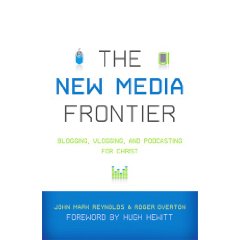 Everyone loves free stuff - so how about a free copy of The New Media Frontier, by John Mark Reynolds and Roger Overton. I contributed to the book by co-writing chapter 5 on podcasting and new media. Crossway, the publisher, will be sending a free copy of the book to the first 30 people who agree to post a review on their blog or Facebook page. Here are the details:
- Send an email to marketing@crossway.org with the subject "New Media Frontier Giveaway" with your name, mailing address, and blog address.
- Crossway will send you a shiny new copy of The New Media Frontier.
- Read the book and post a review on either a blog or your Facebook profile so all your friends can see it by October 31st, 2008.
- Cross-post your review on Amazon.com
Thursday, July 10, 2008
Google goes 3D with Google Lively
Google Lively is Google's move into the 3d world. One thing that is neat about google lively is that after you download the installer, it runs in the browser and allows people to place their virtual rooms on their blog or websites. Therefore, I could put a link to my virtual world on TerenceOnline and you could meet me in the 3d realm of my blog. That's kind of neat. Another neat feature about the system is the kind of animation the characters can do, specifically fighting moves. It's kind of funny to watch a bunch of avatars throw each other around in a virtual space, though I'm not sure there is much educational value in it. If you are interested in 3d worlds, go ahead and check it out. This is Beta so they are working out the bugs. How do you think it compares to other virtual environments such as Second Life and Small Worlds? What educational advantages do these environments provide for students? Let us know what you think.

[an island in google lively]
Info from the website:
Create an avatar and chat with your friends in rooms you design
Requires Windows Vista/XP with Internet Explorer or Firefox
By using Lively you agree to these Terms
Create your own virtual space
Chat and interact with your friends in rooms you design
Express yourself
Customize your avatar and stream personal photos and video
Add your room to your site
Invite your friends to chat and help decorate
[an island in google lively]
Wednesday, July 09, 2008
Using ScribeFire to fire up TerenceOnline!

I just installed the firefox extension ScribeFire, which will allow me to write TerenceOnline blog posts directly from my Firefox web browser. This should make blogging more efficient and effective for me. It has a "blog this page" feature built into the browser that allows me to quickly and seamlessly make a blog entry about a web-page I am visiting. The Firefox web-browser is the killer app to get the most out of the internet and ScribeFire is just another tool in the FireFox arsenal to make it that much sweeter. If you are a blogger and want increase your production, give ScribeFire a try. This is my first post using the tool so hopefully it works well.
ScribeFire - Fire Up Your Blogging!
Wednesday, March 26, 2008
Bowling Green State University goes Web 2.0
 As any reader of my blog knows, I have written about the important role I believe web 2.0 will play in academia. (See Web 2.0 and Higher Ed, Blogging in academia, Blogging Academia, and the Stanford Blog Directory,and University 2.0)
Not being one to just sit idly by and talk about the important role web 2.0 will play in academia, I decided to put words into actions and design a weblog and podcast system for Bowling Green State University. I built the system on the technological framework of WordressMU with many personal customizations. The system is in perpetual Beta so we can test new features, collect feedback, and continue to refine it. There are so many creative ways to use this system (See our About page for some examples). Below are several real life examples of ways the BGSU community is already stretching the creative boundaries of the system:
One English instructor at BGSU, Amanda McGuire Rzicznek, is using the system to podcast her lectures and blog her writing tips, news, and announcements (see her English 111 blog & English 112 blog). She is also having each of her students create their own weblogs on the system, which they use for reflective writing, collaboration, and feedback (see one of her students blogs here).
My office, COBL, is using our COBL@BGSU weblog as a web 2.0 portal to communicate our services to the university and to display our distance learning Resources, Announcements, Newsletters, Podcast, and Photo Gallery. The nice thing about our weblog page is that it is very dynamic and enables email subscription, RSS feeds, Podcast Feeds, and lots of other things the tech junkies of the world love). Plus anyone with admin rights can update the site without having to know any HTML. One of our instructional designers, Michael Kudela, is a huge flickr fan so we can even manage our photo gallery from his personal Flickr account. Now that is cool!
Did I mention that I built this system using all open source tools? Yeah. That's pretty cool too.
Sports and Recreation is a huge part of the BGSU culture. If you ever go to an intramural flag football game at BGSU, you would think you were at the superbowl. Well, the sports and rec people at the university saw the potential of a community blog for their users and contacted me to help them get it set up. It required a little more programming and customizing, but in the end they will have a community of sports rec bloggers. I can see the bragging rights go up even more with this outlet. Their community weblog will be launching soon so I look forward to seeing how that community uses the web 2.0 environment. Check out the Rec Sports Wire to see what they are doing.
The MBA department is using their weblog to give current students the opportunity to share the ins and outs of their daily life so if you’ve ever wanted to know what’s it like to be a graduate student, you’ll want to check it out at - BGSU MBA
The benefits of blogs and podcasts are far reaching and are transforming the way people interact and learn from each other. BGSU faculty, staff, and students can all reap benefits from blogging and podcasting.
Thanks to Connie Molnar and Dr. Bruce Edwards, my bosses at IDEAL, for allowing me to dream, innovate, and design this system for BGSU. They are both great leaders and visionaries at BGSU.
Friday, January 04, 2008
Huge list of learning resources - Happy 2008
Happy 2008! I'm back from break and ready to begin a new year of exploring the horizons of technologically enhanced education, critical thinking, global impact, resource gathering, and blogging to share it all with you. To get started, here is a great list of Learning Resources you can sift through to add to your collection. Yes, the information is abundant, and seemingly endless, but those that do something with it, apply it to life, and make things better is what really counts. Plus, it is a wiki so you can add to it if you are so inclined. Institutions of higher education should be excited about an information based economy and the revolution of knowledge that is going on in the world. However, they should also be concerned if core faculty are not readily embracing it and in fact fighting the rapid exchange of information.
Friday, November 30, 2007
Blogs in Plain English
Anyone looking for a good video to explain to others why blogging is so powerful. Check this one out by the folks at the Common Craft Show.
Wednesday, November 28, 2007
The 2007 Edublog Awards
Looking for more good blog resources? Check out the nominees for the 2007 Edublog Awards. Categories include:
1. Best individual blog
2. Best group blog
3. Best new blog
4. Best resource sharing blog
5. Most influential blog post
6. Best teacher blog
7. Best librarian / library blog
8. Best educational tech support blog
9. Best elearning / corporate education blog
10. Best educational use of audio
11. Best educational use of video / visual
12. Best educational wiki
13. Best educational use of a social networking service
14. Best educational use of a virtual world
1. Best individual blog
2. Best group blog
3. Best new blog
4. Best resource sharing blog
5. Most influential blog post
6. Best teacher blog
7. Best librarian / library blog
8. Best educational tech support blog
9. Best elearning / corporate education blog
10. Best educational use of audio
11. Best educational use of video / visual
12. Best educational wiki
13. Best educational use of a social networking service
14. Best educational use of a virtual world
Thursday, October 11, 2007
Blogging, academia, and the Stanford blog directory
When I stated in May 2007 in a post about Blogging and Academia that "I believe blogging is going to play a much greater role in the future of academics and educational institutions," I didn't know exactly how soon some big name universities would be addressing the issue. Last week, Stanford University launched the Stanford Blog Directory, as a solution to capture and index the collective blogging wisdom coming out of the university community (faculty, staff, alumni, etc.). Harvard has also made some waves in the academic blogosphere by enabling anyone with a harvard.edu email address to start a blog, which is then maintained and indexed on their system. I can't say too much right now, but I am involved in efforts at my own university to develop and facilitate an effective and innovative approach to enable and index academic blogging AND podcasting (more on that later).
One complaint about the open nature of web 2.0 is that any fool can say what they want, however, on the same token any intelligent person can say what they want as well. For this reason, premier learning institutions around the world should play a leading role in facilitating and indexing blogs for their community. Every educational institution should seriously consider creating a blog directory for faculty, staff, and alumni, so that the world can really see what kind of ideas come out of various learning communities around the world. What do others think about this issue?
One complaint about the open nature of web 2.0 is that any fool can say what they want, however, on the same token any intelligent person can say what they want as well. For this reason, premier learning institutions around the world should play a leading role in facilitating and indexing blogs for their community. Every educational institution should seriously consider creating a blog directory for faculty, staff, and alumni, so that the world can really see what kind of ideas come out of various learning communities around the world. What do others think about this issue?
Friday, September 28, 2007
The young blog their way to a publishing revolution
Blogs have made publishing to a world-wide audience as easy as Blogger.com's 1-2-3 steps to starting blog. Expression and communication online are growing rapidly. According to Technorati, 1 new blog is created every second. People love the idea of publishing, sharing, and consuming information rapidly. It feels like light years to wait for the morning paper to get the news. A world in which everyone has a voice is becoming more and more of a reality. Universities around the world should take notice of their upcoming students and how they interact with information and communicate online. They will be attending your school soon, so you must ask yourself the question, "How are we adapting to the needs of our students and the world in which we live where information moves at the speed of light?" At my university, the IDEAL office (Online Education Team), of which I am a part of, are constantly researching new technologies, testing new modes of communication, building and implementing web 2.0 environments, and assisting faculty in applying these new technologies to enhance instructional strategies. The following article describes the personal publishing revolution and why a third of all young people have launched a blog online. Read Article
Wednesday, August 15, 2007
Web 2.0 and Your Own Learning and Development
Here is a good informational video by my friend, Stephen Downes, about how Web 2.0 supports interaction, usability and relevance in online learning. After watching the video, go to the discussion board for discussion. Discuss Web 2.0 and Your Own Learning and Development
Monday, June 04, 2007
Google acquires feedburner
Feedburner is an excellent resource for bloggers and now google owns them too. You know all of those little subscription icons on the right hand side of the screen. Feedburner creates those and makes it easy for people to subscribe. "Chicago-based FeedBurner is a leading provider of feed distribution and management tools. A web feed is a way for online publishers to syndicate their content and deliver it straight to readers. Each day, FeedBurner delivers feeds to millions of users around the world and offers unique and useful tools for publishers to analyze, optimize, and monetize their content. Further, FeedBurner offers a feed advertising platform for advertisers to reach engaged feed readers through targeted in-feed ads and innovative techniques like RSS feed-driven ads. Read entire article
Tuesday, May 08, 2007
RSS in Plain English - A Must See Video!
Finally, a video in plain english that explains one of the most important Internet technologies that is revolutionizing the internet and making it better...RSS. This video is a great follow-up to my previous post on Blogging in academia. This video simply demonstrates the power of the blog and RSS technology. His favorite reader, as mentioned in the video, is Google Reader, but I find Netvibes works much better for my style (Netvibes is my personal learning environment packed with feeds, podcasts, vodcasts, to-do lists, bookmarks, and much more). I'll make a post on the power of personal learning environments later, but for now, enjoy the video and be prepared to completely understand RSS.
Monday, May 07, 2007
Blogging in Academia - The Future
I believe blogging is going to play a much greater role in the future of academics and educational institutions. The Information Age in which we live is moving us in the direction of a knowledge based economy. In this knew economy where information is created, shared, and re-mixed at the speed of light, consumers demand quality, up-to-date, relevant information, and they want it now! Professors that blog are moving in this direction and their students will recognize and appreciate it.
It's similar to the way computer companies have evolved their business model for developing new software. They realized 2 major things: (1) that people would rather have something to use in a Beta version than years of waiting for a product that ends up being buggy anyhow (2) the feedback they get while in Beta version enables them to make a better product more quickly. It is a move from the Microsoft model (wait 5 years for a substantial upgrade) to the Google model (perpetual upgrades).
A teacher that blogs is like a company moving from the Microsoft model to the Google model. The following is a great example of a college professor using a blog effectively in the field of higher education. Notice the rich media, large network of related blogs, and tons of resources, which makes this blog a jackpot for anyone interested in journalism. I'm sure her students appreciate it. Check it out here - http://mindymcadams.com/tojou/
It's similar to the way computer companies have evolved their business model for developing new software. They realized 2 major things: (1) that people would rather have something to use in a Beta version than years of waiting for a product that ends up being buggy anyhow (2) the feedback they get while in Beta version enables them to make a better product more quickly. It is a move from the Microsoft model (wait 5 years for a substantial upgrade) to the Google model (perpetual upgrades).
A teacher that blogs is like a company moving from the Microsoft model to the Google model. The following is a great example of a college professor using a blog effectively in the field of higher education. Notice the rich media, large network of related blogs, and tons of resources, which makes this blog a jackpot for anyone interested in journalism. I'm sure her students appreciate it. Check it out here - http://mindymcadams.com/tojou/
Tuesday, October 24, 2006
Web 2.0 Taught at University

It looks like IBM and the University of Arizona are teaming up to offer courses that teach strategies for implementing web 2.0 in the business world. Web 2.0 is basically a read/write version of the Internet which takes advantage of social networks and enables both the site designers and the users to contribute content. For example, this blog is a web 2.0 concept in which, I write content, and my readers are able to contribute content back via the comments feature. This blog also takes advantage of the social network concept in which I am displaying feeds and links from other folks with similar interests. Check out the official article here http://www-03.ibm.com/press/us/en/pressrelease/20459.wss
Wednesday, October 18, 2006
Should All Learning Professionals Be Blogging?
In response to The Learning Circuits Big Question, "Should All Learning Professionals Be Blogging?" I will respond in a manner I feel is consistent with elearning; Simple, Concise, and Pointed.
- I think anyone that is motivated to share ideas should do so.
- I think that sharing ideas is powerful and blogs certainly make the process more efficient.
- With power comes personal responsibility. Who would watch the content for errors, falsifications, etc.
- I think systems connecting, disseminating, and ranking blogs similar to the way Digg ranks tech news stories would be one way to place checks and balances in the blogosphere.
- I would personally like to see professors from all over the world blog in their area of expertise and then use a system like Digg to rank the blogs.
- I would recommend to learning professionals that blog to keep it simple and relevant. Don't turn your blog into an academic journal.
Subscribe to:
Posts (Atom)